RV Dreaming

The great thing about dreams is that you can dream whatever you want.  Dreams don’t have to be grounded in reality.  Sometimes though you can realize your dreams even if only for a short time.  Cristy and I got to do just that for a few hours this past weekend.  We traveled down to Pomona to visit the Best RV Show at the Pomona Fairplex.  Or goal was to evaluate the two models of Grand Design 5th wheel coaches we had been considering.  Then we experienced the first of two surprises this year at the show.

The first surprise was that Grand Design has introduced a new model and we fell in love with it.  It’s Grand Design Solitude 300GK.

solitude-300gk-060216

We like the fact that it’s only 35 feet long, has a separate closet for the washer/dryer, and a telescoping TV that reveals a huge picture window when the TV is lowered.   Which is where we’ll probably keep it.  Our absolute favorite model is the new 360RL but at almost 40 feet long is just a little too long for us.  Most state and national parks cap out at 35 feet so that’s what we’re trying to stick to.

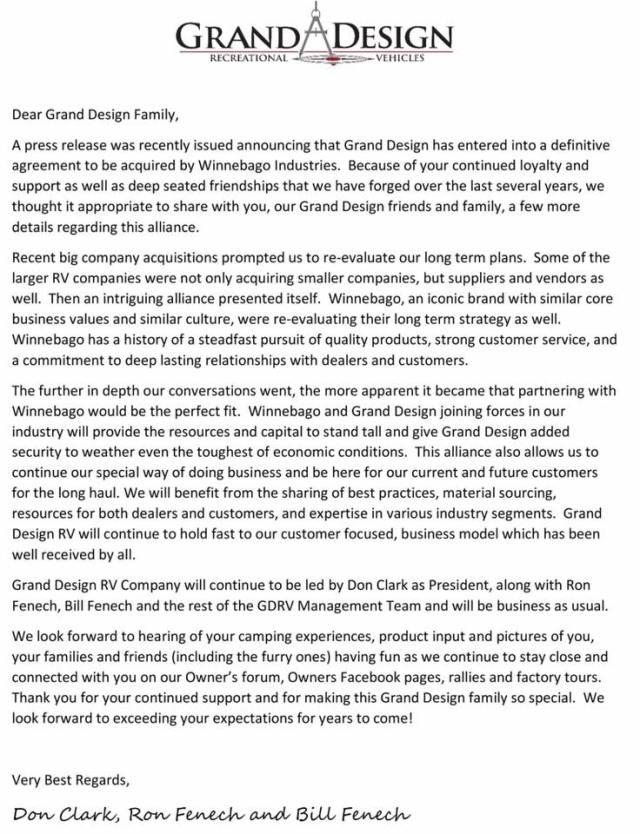
The other surprise was that we found out that Winnebago has purchased Grand Design RV.  We aren’t sure how to take this news yet.  It could be very good depending on what the intentions of Winnebago are but it could also spell the end of Grand Design as we know it.  Since we are a few years away from purchasing we have time to find out.
14492321_10208935834187581_3826739172980356035_n

As I read this press release the more I think that Thor was probably posturing for a hostile takeover of GD and they decided to ally with a name synonymous with the RV industry rather than get swallowed up by Thor.  At any rate as I already said, time will tell.

Despite this news Cristy and I really enjoyed our time away.  We got to be with each other and spend time talking or just being quiet and enjoying the passing scenery.  Car travel has kind of become our refuge from the world.  We load up our snacks, crank up our favorite tunes on Spotify and hit the road.  It’s fun to dream about when this will be our reality.  For now we get to live it in bits and pieces and that’s enough.  For now.
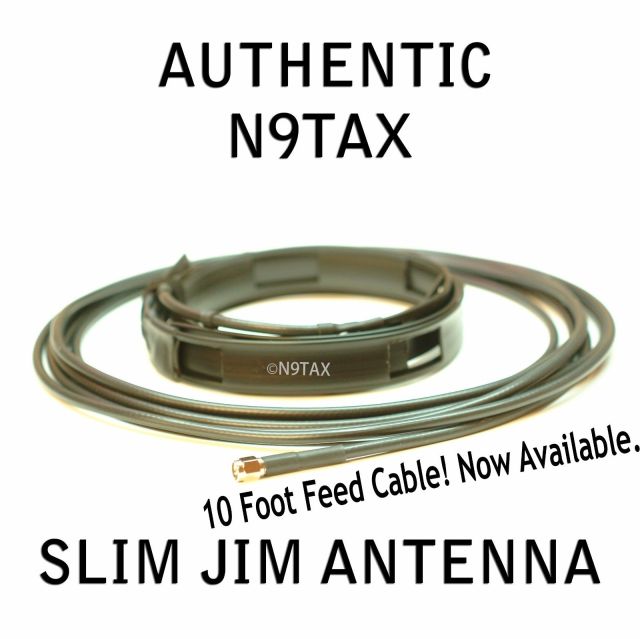
 

Flexible J-Pole Antenna

I’ve been looking for a small powerful antenna for my Yaesu VX-6 and KK6ES recommended this to me…

s-l1600

It’s basically a roll-up J-Pole antenna.  I have a line with a weight on one end that I can toss up over a tree branch and just pull it up into a the tree and use that as a mast.  I tried it out the other night and was able to get really good transmission and reception on a local repeater.  It was marginal with the rubber ducky antenna that came with the radio.

Today I tried to come up with a portable mast.  I have a telescoping windsock pole that I use when I fly my powered paraglider but it’s made of aluminum and the antenna is not as efficient when hung next to metal.  So I bought some sections of PVC tubing and some slip couples and made a mast.

img_20161001_145715458_hdr-1

However, it was too floppy.  I had to use the tree to prop it up so that it wouldn’t flex too much.  If I can come up with a way to stiffen the PVC pipes it will work nicely.  Or… maybe the folks out there have better ideas?

Fuel Primer Repair – Part 3

After measuring how much fuel primer line I would need I threaded it through the protective mesh webbing and added heat shrink tubing on both ends of the mesh.

img_20160922_181949892_hdr

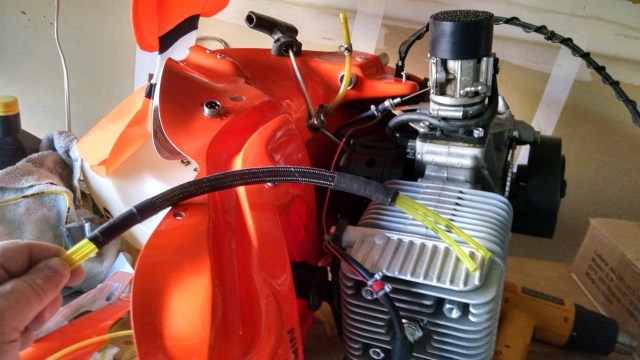
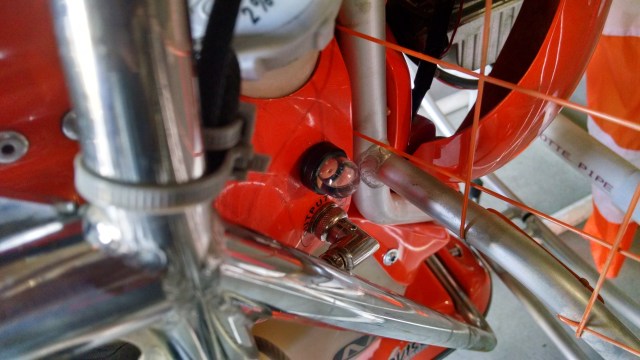
Then I heated the tubing ends up in boiling water to help them stretch and slide over the fittings on the carburetor more easily.  I secured the carburetor end of the primer line and then slide the primer bulb ends of the tubing and mesh through the hole in the Rodeo Nirvana backshell.  I had to file out the hole a little because the primer tubing was slightly thicker walled than the orginal tubing.  I added some Gorilla Glue and then propped the motor up so that the glue wouldn’t run.  A little tape around the hole in the backshell prevented (most of) the glue from running out the hole.

After the glue dried I cut the tubes to length and pushed them onto the primer bulb fittings.  I put a dab of superglue on the tube ends to make sure they stayed on the primer bulb.  I did not glue the primer bulb to the backshell but just left it snapped in place.  If no leaks develop then I’ll glue it in.

img_20160925_180503756_hdr

Fuel Primer Repair – Part 2

First of all it was a beautiful day here in California’s vast Central Valley.  It was sunny and 100 degrees here a few days ago and this morning I woke up to 62 degrees and this…

img_20160921_073023489_hdr

It’s a great way to usher in Autumn.  But I know that it will get hot again in a few days.  I’m just enjoying the cool weather until then.

Fuel Primer – Part 2

My workaround has been working great but it’s not a permanent fix.  I started on the permanent fix today.  This required removing the engine from the trike, removing the fuel tank, removing the workaround primer, and removing the old primer line.

After removing the old primer line I salvaged the sleeving used to protect it and ran the new primer ine through it.  I still need to get some heat shrink tubing to protect the ends of the sleeving and to secure the fuel lines inside it.

Tomorrow I’ll get the heat shrink tubing and hopefully finish off this repair.

Sunday morning flight

I’ve had an opportunity to test out my PPG engine primer fix.  The primer bulb is just temporarily attached near the carburetor but works very well.  It’s not a long term fix but will work until I get some fuel line in to make the rest of the repairs.  I did the first test flight at my home base at Oakdale Airport.  All seemed well so I went for a longer flight this morning out at New Jerusalem.  I blew the first launch but the second went find and I had a real nice flight around the river.

First QSL Card

Making contact with other Ham operators are what Ham operators love to do.  The code for this is QSL.  It has become tradition for operators to send a QSL card as proof of the contact.  Whether across the state or across the globe many Hams still do this.  It was a privilege of mine to have a dear friend be my first Ham contact.  He is a radio engineer and a dear brother in Christ.  He doesn’t get on the Ham bands much anymore but made an exception for me.  We chatted as he drove home from Modesto to Valley Springs.

I was so excited about my very first Ham contact and conversation I decided to make up a QSL card of my own.  Note here that it is tradition to send paper QSL cards, which are very similar in size to a standard postcard.  Being in the digital age I decided to email him.  Here is what I sent:

qsl

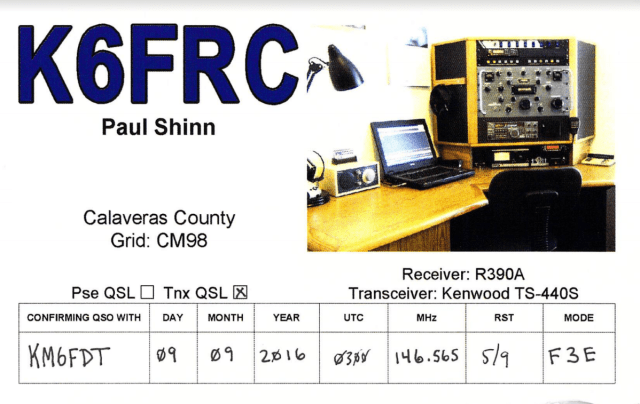
A few days later I received the following in the mail:

k6frc

Anyway it was really fun to carry on this tradition with a very good friend who has been very encouraging of me to get my Ham license.

KM6FDT clear

Nirvana Rodeo Engine Maintenance

The Rodeo engine (made by Nirvana) had it’s first maintenance issue this past Friday.  It was just bad enough to ground me though a relatively easy fix.  I say relatively because I have to take the entire trike apart to make the repair.  The problem was my primer bulb.  When I tried to prime the engine this past Friday I pulled back a very smelly and wet finger.

*Pauses to let laughter subside*

When I looked at my primer bulb it had developed a pinhole leak.  If I tried to start the engine without priming a very fine stream of gasoline would come out of the bulb when the engine was turning.  Not a good thing.  So I grounded the machine until it could be repaired.  And for those who don’t know what a primer bulb is… it’s a small pump basically.  You press it with your thumb and it squirts fuel directly into the carb which helps the engine to start.

I said earlier that the repair is ‘relatively’ easy  because the repair is a simple matter of replacing a $2.00 primer bulb.  It snaps out and back in.  The ‘relatively’ part comes into play when you’re trying to gain access to the primer bulb.  To get it out you basically have to take the entire machine apart.

First I had to remove the propeller, the propeller cage, and the seat and harness.

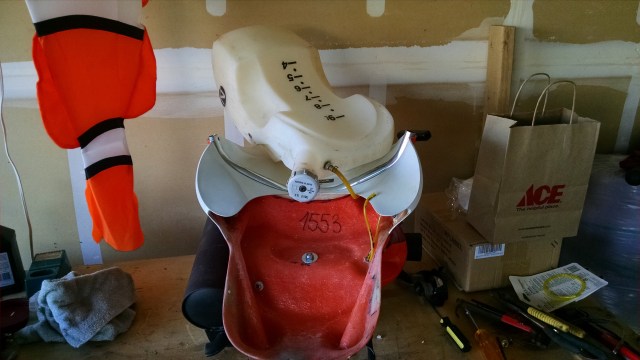
Then I had to remove the engine from the trike and dump the fuel back into the gas can.  Most of it made it back into the can.  After I had the engine up on the workbench I had to carefully remove the fuel tank.  This is kind of difficult with one person but can be done with patience.   Note that the gas cap was removed when I removed the tank, I put it back on to keep contaminents out of th tank.

img_20160911_164908463

With the tank removed I could then get at the back side of the primer bulb.  I removed the fuel lines from the primer and labeled them so the would go back on in the correct positions.  On the carb end I labeld them L and R for left and right.  On the primer end I labeled them S and L for short and long which correspond to the fittings the fuel line was removed from.  One is short, one is long.

After that it was a simple matter of squeezing the locking pins together and popping the bulb out.

Once I had the bulb out I could see that the pinhole had quickly become a bigger hole just with vibration and a little bit of manhandling which it got when I removed it.  It’s hard to see but the entire middle of the bulb is about to come off.

img_20160911_164211288

Apparently this is a fairly common part on chainsaws and similar small engine equipment.  I found a box of 5 on Amazon for about $6.00 and it will arrive on Tuesday.  I’ll post an update when I put it all back together.


Even More Ham

In my last blog entry I talked about taking the Amateur Radio test up in Granite Bay.  I didn’t go into much detail on the testing process so I’ll add a little about that here.   The local club in Granite Bay gives tests every Saturday at Raley’s.  Yes, Raley’s.  There is a community conference room at the back of the store and this is where you’ll find the local Amateur Radio club every week.  When you first walk in you are given a packet with some forms to fill out.  Simple stuff like name and address and FRN number if you have one.  The FRN number is how the FCC identifies you in their database.

In the packet is the actual test and answer sheet.  If you’ve ever taken standardized tests in school where you fill in the bubble it’s very similar.  Don’t write in the test booklet, completely black in the answer number.  After you’re done with the test you hand it to the graders.  It is a group of three people who are usually “elmers” or older more experienced Hams.  They each graded it as a cross check.  When the last guy checked my answers he gave me a big smiling “thumb’s up!”

After that they told me it would be a week to 10 days before my license appeared in the FCC database.  This can be checked on the FCC’s website.  I had the page bookmarked and checked every morning and evening this week.  This morning before work, my name was not there.  On a whim I checked when I got to work and there I was!

Now that I have a call sign I am legal to talk on Ham radio.  I have a good friend who will be in my area this evening and we are going to try to arrange it so that he will be my first radio contact.  We are going to communicate via what is called simplex.  This means we will be communicating radio to radio not using any repeaters.  Repeaters allow to boost your range.  We’re going to keep it simple for tonight.  He’ll be within a couple miles of me anyway so simplex should work just fine.

One other thing I’ve done is request a vanity call sign from the FCC.  This will allow me to use a slightly shorter and more meaningful call sign.  Since I’ve been a pilot for years and years I’d really like a call sign that begins with N.  I’ve put in the application and will update here when it comes through.

de KM6FDT

Ham I am

After a 2 hour drive up to Granite Bay, CA I took the exam for the Technician Class Amateur Radio license.  I was surprised how quickly I blew through the 35 questions and was a little hesitant to hand in my test.  However, I got an excited ‘thumbs up’ from the examiners.  I was told I only missed one question, a 97%.  Not bad at all.  Now the waiting game begins.  It will still be a week or two before my license shows up in the FCC database.  But as soon as I see it there I am good to go!