P3 Lite Shoulder Harness Modification

Since it’s too windy and stormy to fly, I might as well do more modifications.  When I flew the P3, I found that the shoulder harness was too short.  I was unable to COMFORTABLY reach the instrument pod where the starter and kill switches are.  To remedy this I took a piece of scrap steel angle I found at work, trimmed it down, and drilled it out to accept the bolt that previously held the harness on the P3’s upright.  I still need to paint it and I need another bolt but… it fits perfectly and allows me more room to move around.  More importantly the switches on the instrument pod are within easy reach now.

P3 Lite Propeller Cage Modification

Although I had ZERO problems taking off I installed the following propeller cage hooks on my P3 Lite.  These hooks will allow my to lay out my canopy in a little more orderly fashion and will greatly reduce any probability of the lines getting hung up on the cage or sucked into the propeller.

The Dutchman Flies Again

Well if last Saturday was great, this past Saturday was greater!  I returned to Lincoln airport and their powered parachute field hoping to fly my P3.  It’s a long drive and I really didn’t want to drive all that way again but it was the only place in the Central Valley that wasn’t experiencing high winds.  And really there is quite a community of powered parachute enthusiasts there so it’s a fun place to fly.

I showed up a couple of hours before sunset.  There was one other person there waiting to fly as well.  We chatted and talked about, surprise, flying.  A married couple showed up, he flies a PPC, she flies a PPG.  We all busied ourselves with getting our respective machines ready.  Wings laid out.  Last minute wind direction checks.  I have to admit I was a little nervous as I prepared myself to fly the P3.  It had been 3 months since I had flown as pilot and one week since I had flown a two seat PPC with Ken.  I didn’t do very well flying his machine, or should I say landing it.

Finally I ran out of excuses not to fly so I climbed aboard my machine and gave it the gas.  Now, on my PPC when accelerating you had to guide the canopy up, and steer both the canopy and the machine on the ground until you were flying.  With the PPC the canopy came up and locked itself in overhead as if supported by poles.  It was just rock solid.  I went ahead and pushed the throttle all the way forward and gave my rudders a little kick and up it went.

Once up in the air it flew very much like my PPG did but felt more stable.  Climb rate was slightly less and turns were not as fast when only using the rudder bars.  I could increase the turn by grabbing the steering rope and pulling it in.  I spent about 20 minutes just flying around and making approaches, coming in lower and lower before going around again.  I just wanted to see how fast it reacted to the throttle.   When landing many PPC pilots give a burst of throttle just prior to touchdown, once I was satisfied I knew how much throttle to apply I set up for my landing.

The landing was nothing to write home about.  I was late on the throttle and bounced but it wasn’t bad.  I killed the engine and rolled to a stop while kicking the rudder bars.   Kicking the rudder bars causes the canopy to collapse behind the PPC.  Much better than having it come down on top of you.  All in all a successful flight and I look forward to many more.

P3 Lite PPC Flies

Had a great Saturday this past weekend!  I drove up to Lincoln, CA to meet up with the local Six Chuter dealer.  I wanted to give him an opportunity to give my PPC a once-over and also to help me rig the wing.  There wasn’t much help going on he pretty much did everything.  We headed over to the PPC field and started laying out the wing.  Ken the dealer went over wing layout and stowing.

Then we went for a flight in his PPC so Ken could show me the big difference between PPG’s and PPC’s; the slower response.

ppc

It really did feel like flying a bus around the sky.  At least compared to my PPG.  After a few circuits and a landing I asked Ken to do the first flight on my P3 Lite.

Ken reported that it flew great but needs a little tweaking to get the exhaust gas temperature down.  Will be working on that this week.

P3 Engine Break-In Complete!

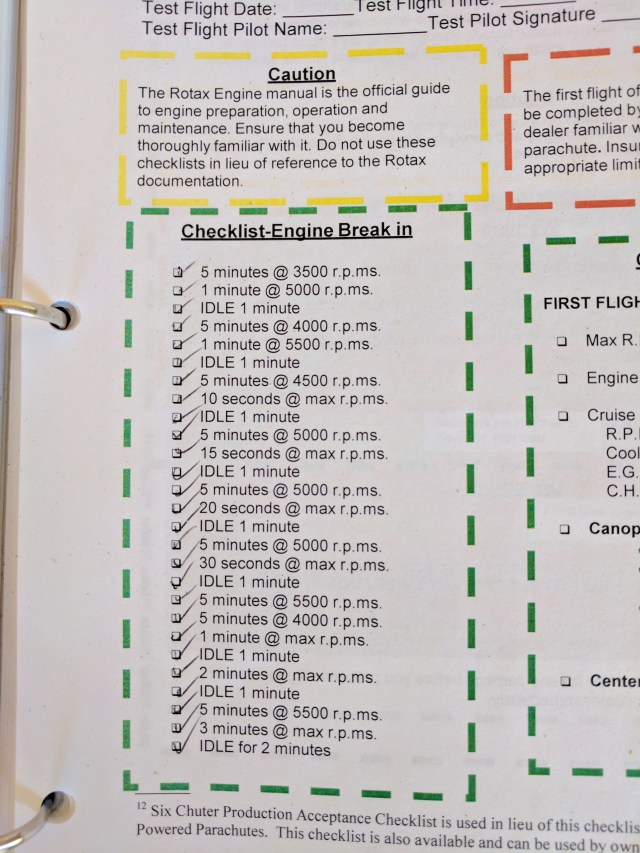
After some back and forth with the factory I was finally able to finish my engine break-in today.  My EGT’s were still running a little hot so I did two things; I started from scratch on the air screw and idle screw on the carburetor, and I CAREFULLY mixed 20:1 Amsoil in some premium auto fuel and replace the fuel that was in my tank with this new gas.  I may have been a little sloppy with my mixing before.  Sure enough, this time EGTs were down where they were supposed to be.  So…

Ta-da!

breakin-checklist

So the next step is to let Ken, the local Six Chuter dealer take a look at it, rig the parachute, and probably let him do the first flight to make sure everything is copacetic.  There’s a possibility of me being able to go up to see Ken on Sunday, but if not then some time next week.  We just have to work around the winds.

PPC Engine Break-In

After the first run of the engine the very next thing you have to do is go through the break-in process.  I’ve been experiencing heating issues with trying to go through the break-in period.  It’s running hot.  I called Six-Chuter’s Rolando and he had me adjust the needle in the carburetor.  This helped but I’m still running overly hot in the 4500-5000 rpm band.

egt

My next steps are to, drain the fuel and put in new fuel, I’m going to double-check the oil/fuel mix ratio to make sure I didn’t mess something up.  I’m also going to call Rolando again to see if there is anything else I can check.

PPC Assmbly Complete!

This is my wrap-up video for my Six Chuter P3 Lite powered parachute.   I only have to items to finish; connect the gas line to the fuel tank, connect the voltage regulator to the battery.  Everything else is complete.  I had to move a few things around when I found I had mounted them in the wrong place.  Now I have holes where I don’t need them.  We call those lightening holes.  An aircraft term used to refer to holes cut to save weight in the airplane. 🙂

Anyway, here’s a wrap-up video…

PPC Assembly Day 10

A few more minor things done today.  There were a few bolts that I wasn’t happy with the sizes, a little too long, a little too short so I ordered some more bolts from Aircraft Spruce.  So with the bolts in hand I was able to mount my starter contactor (solenoid), and mount the regulator more securely.  I also started on the fuel hose and primer bulb.


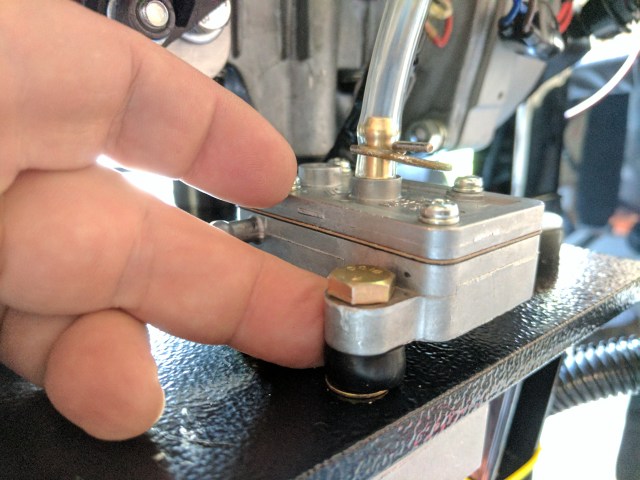
There has also been some talk about fuel pumps.  I’m inclined to keep it in the factory position as they say they have not had any problems reported to them with this setup.

IMG_20170412_182906

However, I’m not opposed to mounting it in a more favorable position, which would be above the fitting on the crankcase (follow the clear hose on top of the fuel pump.)  I just can’t see a way to do that.  Any ideas?

IMG_20170412_182934