Now the the first flight of my airplane is past me, I now have to perform what’s called Phase 1 flight testing. This is to determine the performance of the airplane and what the safe flight parameters are. Today’s flights consisted of confirming the first flight’s test results. The objective of these flights are just to determine that the airplane is controllable using normal control inputs and to correct any squawks or problems you encounter.
Today I had a problem with the tachometer so I landed to fix that and also readjust my flight controls. The airplane currently has a tendency to turn left. I found that readjusting the flight controls wasn’t enough to correct the left turning tendency. Next I added more washout or twist to the right wing. This will reduce the right wing’s lift slightly. I did not get a chance to perform another test flight. Testing will continue on Saturday.
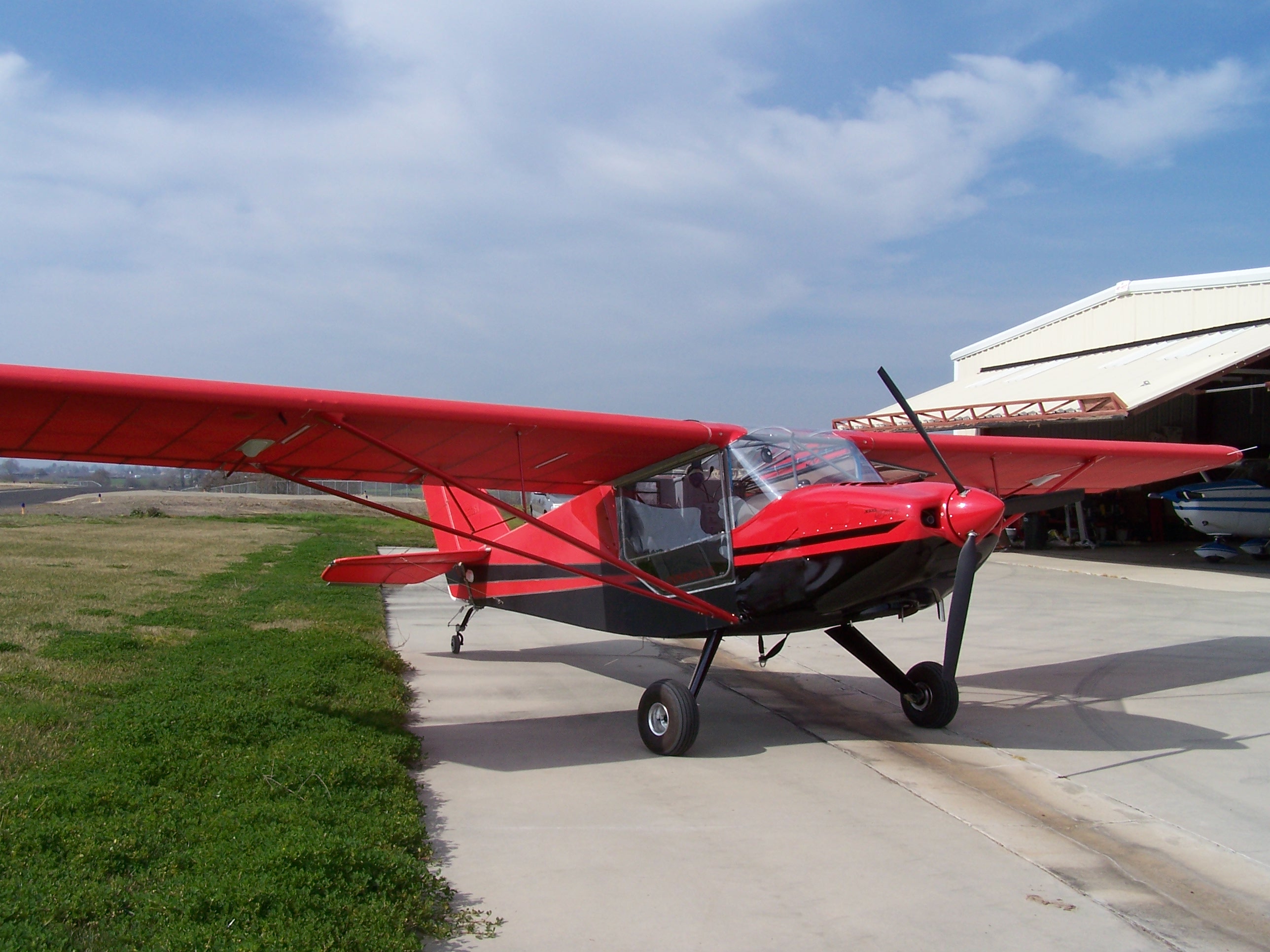
Well after almost two years of construction, and about two weeks of nervous pacing, my Rans S6-ES Coyote finally flew today! Here is the long story for those that want to read it.
N612SV
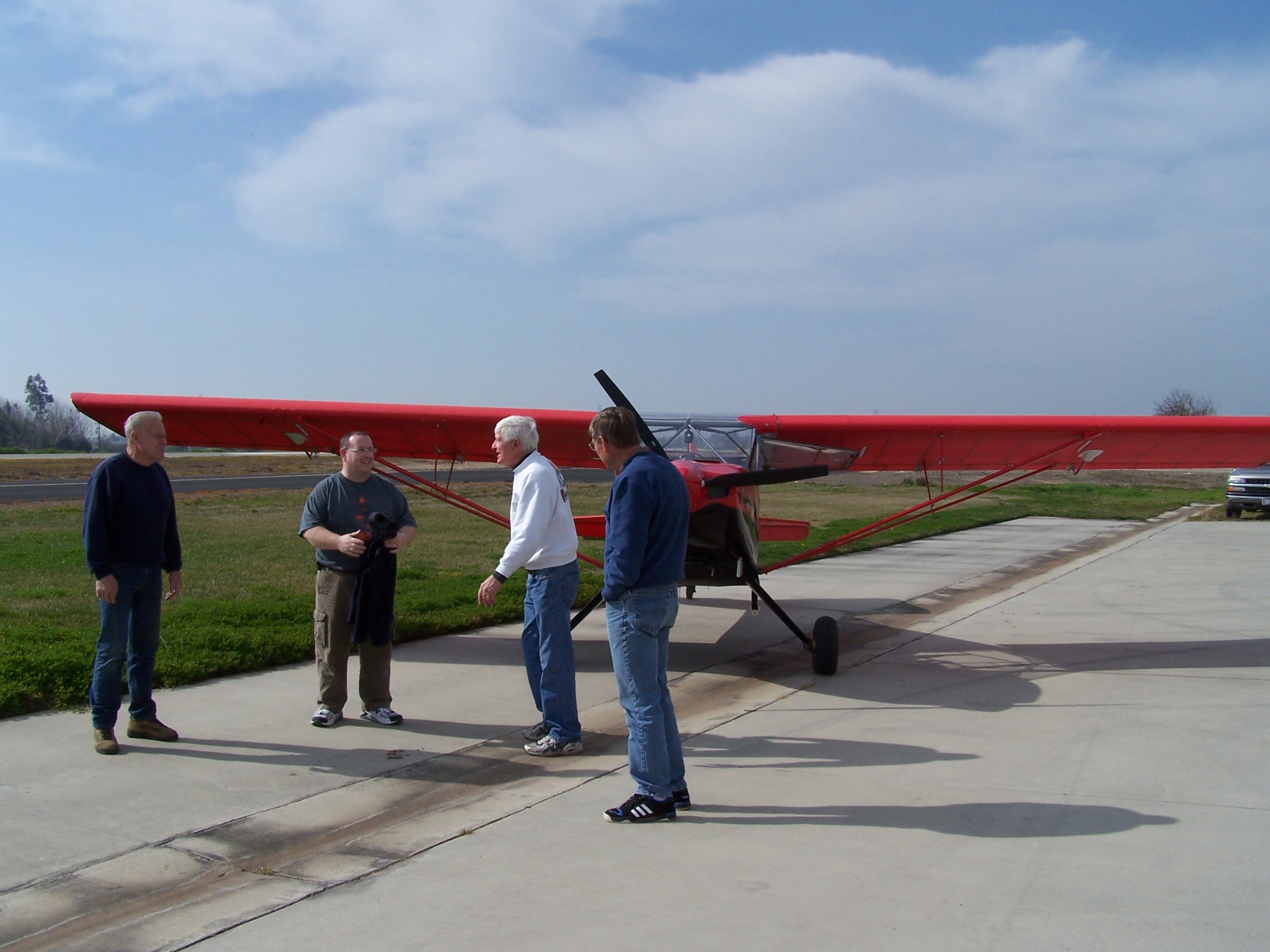
The plan was to gather at Oakdale Airport (O27) at 12:30pm with a scheduled take-off time of 1:00pm. Two pilot friends of mine, Joey Myers and Emmet Welch were to meet me for photos and all around well wishes. I arrived at 9:30am and cleaned the airplane off. I then went to hang out with the guys from EAA, Leon, Jim, Ken. They were definately looking forward to the first flight far more than I was. At about 11:30am Joey texted me that the winds were picking up at Rio Vista and that he was only making 11 MPH ground speed. He elected to turn around and head home. Winds were still light at Oakdale so the flight was still a go for me. Emmet showed up right on time at 12:30pm. However, I could see the wind sock starting to move and fearing that those 35 – 45 MPH winds were headed our way I elected to depart immediately.
After a few photos I climbed in and belted up. Ran through the prestart checklist and fired her up. She sounded good so I taxied down to the runup area. Runup seemed normal. I say “seemed” because I’ve only flown behind a Rotax motor a couple of times. After a short quick prayer I announced on the radio and taxied out on the the runway. I started advancing the throttle slowly to get a feel for directional control and the rudder inputs that would be needed. The tail came up and I made a few rudder corrections to straighten her out and then pushed the throttle in all the way. Only problem is I was too slow because I was already airborne.
As I climbed out I rolled the wings a few times and yawed with rudder. The airplane seemed to respond normally so I pulled back to about 75-80 MPH and climbed out. The wind had already arrived because at about 600 ft MSL I started feeling a lot more bumps and the plane had a yawing tendency. However, they were all easily overcome with correcting inputs on the stick and rudder. I continued the climb until I was at 2500 MSL but the bumps only got worse. It had the feeling of flying through your own aircraft’s wake over and over again. It was more than I wanted to deal with on a first flight so I descended back down to about 1700 MSL where it was relatively smooth and kept it there for the remainder of the flight. Engine instruments all looked and remained normal. I noted a climb RPM of about 5200. Oil pressure and temperature were good. CHT’s looked fairly cool but I didn’t write down exact numbers. I’ll do better at taking notes on the next flight.
After about 20 minutes I decided to head back to the airport before the winds came down to ground level. Two other aircraft entered the pattern just as I wanted to land so I circled a few more times then entered on a left crosswind. I throttled back and kept the airspeed to about 80 MPH on downwind. As I came abeam the numbers I pulled the throttle to idle and put in the first notch of flaps. The wind had pushed me away from the runway so I angled back in a bit on base and added a little power. I pulled in the 2nd notch of flaps and once I was back on the glide path I wanted I pulled the throttle again. On short final I pulled in the 3rd and then 4th notch of flaps. It was her that the first glitch of the whole flight happened. The flap handle would not lock into the 3rd or 4th notch. I had already pulled the handle all the way aft so I didn’t want to let go and dump the flaps that close to the ground. I elected to just hold the handle full aft and continue the approach.
So there I was making my first helicopter landing: the stick in one hand, the flap handle in the other. I go so distracted with all this that I didn’t watch the centerline close enough and allowed myself to crab and drift a bit. I touched down on one main, then the other, then the first again before I finally got everything straightened out. Once down on 3 wheels she handled beautifully. The rudder pedals seem stiff but I’m assuming that they will get easier as they break in. I taxied back to the EAA hangar and shut down.
There are only two squawks I have found so far. The first is that the left wing felt just a little heavy. I’m not going to do anything about that until I flight it a few more times to make sure I felt what I thought I felt. The other is that the flap lever would not stay locked when I pulled the flaps. That could have been my pants getting caught up in the lever though, I’ll check again next time I fly. There is one other change I might make and that is to change the rigging on the elevator so that I don’t have to pull the stick so far aft to get full up elevator. That or lose some weight.
The first flight was a success! After a week of worry I found that it flies normally, everything works, and lands normally. Now the fun can begin!
This afternoon I performed the last few checks on the plane. Lube’d the flight control hinges. Checked deflection on all flight controls. Secured my fire extinguisher (may I never need it.) I also took this opportunity to taxi around the airport a few times to get a better feel of the ground handling. I tried to be a little more aggressive on the rudders but I’m still trying to feel out this machine.
It looks as if a small crew will assemble to wish me well tomorrow including a couple of internet buddies. It will be nice to have them on hand so I can ask some last minute questions. I’ve had several people offer to fly chase, if each of them shows up, we’ll look like a squadron of angry geese (only slower.) Either way I’m feeling more confident now and starting to look forward to this first flight. It all comes down to this moment.
That’s what pilots call telling stories, usually lies about their flying adventures. Here’s one of my hangar flying stories.
We all decided to fly to Nut Tree in Vacaville to have lunch. One of the planeless pilots rode with me in my old Aeronca Champ. He was a talker, a very animated talker. Even though we were wearing headsets and could hear each other just fine, he felt obliged to lean forward to every time he said something to me. The thing you need to know about the Champ is that it is tandem seating, the passenger sits behind the pilot. So each time he’d lean forward the plane’s center of gravity was upset and the nose of the plane would dip. I’d reach up to the trim control and retrim the airplane to fly level. Then he’d stop talking and lean back. Then the plane’s nose would rise. I’d reach up and adjust the trim again. By the time we got back to Oakdale my arm was so sore from adjusting that trim tab. I was happy to bid him good-bye.
Not a a tale of daring-do but still, one of my hangar tales.
My pastor and his wife have been on a long, tiring journey to adopt a child from overseas. Recently God, in one of His lighter moments, decided to bless my pastor with not one but TWO adoptions. (It’s a long story) I wanted to help them in some way but I don’t have much money or talent… but I can fly. So when my pastor took the decision to hold an auction to raise money, I donated my skill in the way of a one hour site-seeing flight.
A woman bid and won the flight for her parents. I took her parents on that flight this morning. We flew over Milton and the Salt Springs Valley and just generally enjoyed the cold, crisp, still morning air. My favorite part of the flight was when one of my passengers yelled to be heard over the engine noise; “IT’S SO PEACEFUL UP HERE!” And she meant it! 🙂
So, thank you Tanya Cantrell for buying this flight for your parents, and thank you Kiana and Jerry Sommers for being my passengers this morning!
Years ago I remember reading a response posted to rec.aviation.military in answer to a user asking how he could make his military flight simulator more realistic. He wanted to build a realistic cockpit setup for his “misions.” This is the response to the best of my memory:
Take two cynderblocks and place them together on the floor in front of your PC and monitor. Find a piece of plywood and place it behind the cynderblocks and prop it against something sturdy like a wall. Arrange the cynderblocks and plywood into a seat. Stretch a thin piece of fabric over the cynderblocks. This is your ejection seat.
Obtain either a heat lamp or an old doctor’s examining lamp. Place it next to your ejector seat so that the lamp will be shining directly on your head. This will simulate the sun. Angle it toward your eyes for ultra-realism.
Take a backpack and fill it with old cloths, rope, and tools. Pack it as tightly as possible. Try to compress it so that it is as flat as possible. Make sure something sharp is located right between the shoulder straps so that it presses into your back when worn. Strap it to you as tightly as possible. This will simulate your parachute.
Make a bologna sandwich and leave it out for a few hours. Then gently wrap it in plastic and step on it. Toss it in a small box with a badly bruised apple and a warm box juice drink. Close the box. Step on the box. Place the box under the heat lamp in your “cockpit.” This will simulate your box lunch for your mission.
For ultra-realism find a real military style helmet with oxygen mask. Strap it on tightly. Soak a rag in kerosene and let it dry. Then place it in the tube connected to your oxygen mask. This will simulate the on board oxygen system of your aircraft.
Now you are ready. Turn on your heat lamp. When the ejection seat feels warm go ahead and have a seat. Turn on your PC and get your flight simulator software going. Once your aircraft is loaded on your computer and ready go, sit there for an hour. Go through the checklist while you are waiting. After an hour under the heat lamp, begin your mission. Make sure it takes at least 4 hours. Do not under any circumstances leave your ejection seat during this time, that’s cheating. Feel free to enjoy your lunch at any time.
For even more realism, have your wife wake you up in the middle of the night. Put on your flight suit and helmet and run down to your simulator. Put on your helmet and parachute while you are running to your “aircraft.” Get in and fire up the PC. Go through the checklist and then sit in your cockpit waiting for your launch orders. After an hour have your wife come back and tell you to “stand down.” Shut everything down, take off your gear, and go back to bed. Have your wife do this a couple times per week and even a couple times per night at completely random intervals.
Congratulations! You now have the most realistic flight simulator possible.
Spent a really nice evening yesterday getting acquainted with N7160L, a Grumman Traveler. Some friends own it and have agreed to allow me to fly it while I am building my aircraft. I went up with an instructor who had been working with my friends on their checkouts and some flight training. Really great instructor that I recommend highly. Mike Liese. Shoot me an email if you want his contact info. We spent about 30 minutes on the ground and one hour doing air work. I am now cleared to fly the Grumman!
I’ve heard some talk about town about how rich I must be to be able to build an airplane. Nothing could be further from the truth. In fact, I sold an airplane that I had paid for in full over time to finance this project. This aircraft is being purpose built to sell. I repeat, this aircraft is being built to sell. This is an apprenticeship for my son as I really have no other skills to teach him.
Thanks for letting me set the record straight. God bless you and yours.
I found a cool website, http://ourairports.com It allows you to mark all the airports you’ve flown to on a google map. It also allows you to enter comments about the airports you visit both as a pilot and as a passenger. Here are the airports I’ve entered so far:


 Air Prayer